Sunday, 28 February 2010
Maui, West Africa
I learned some huge lessons this past week about performing West African music ... at least on Maui.
The beauty of the music is that despite its inherent complexity and potential for precise arrangements, it also works well “on the fly” if the players are versed in the basic rhythmic patterns and if a soloist or two is on hand to add dynamics. With a dancer featured on the floor, even just a steady groove can be enough to build momentum - even trance - and hold the interest of the audience. And if things take off to inspire others to dance, so much the better. Then the energy takes off and the initial concern about parts and arrangements gives way to sheer fun.
First, an event highlighting cultural dances was scheduled for Lulu’s, a bar/restaurant in Kihei, the main tourist strip on Maui. A few of us who had been drumming for African dance classes were asked to play some rhythms for a visiting Guinean dancer named Simbo, and also a Haitian piece for Lasensua since we’d also been playing for her class. I was looking forward to this mainstream exposure for the traditional music we had been playing; especially since even when I was contemplating living on Maui I imagined that Kihei would present the most opportunities to perform - though I had thought that playing in mainstream venues would mean only token inclusion of the African drum and percussion elements into electric bands.
In a short practice at Rainbow Park in the afternoon, we drummers rehearsed Konden, but when Simbo showed up in Kihei and we went across the street to Kalama Park for a run-through, he wanted Dunungbe. This was a tricky part for the sangban and it didn’t mesh well right away, so he changed the plan to Kassa and taught us a short break for the arrangement for his dance. So far so good.
Once in the venue as it was about to start, however, we looked at the program and got confused. It listed the “African Drummers” first, then Cuba, then Simbo, then Joel, then Lasensua. And the organizer informed us that were supposed to play for all four of these dancers in succession, after our opening piece. Meanwhile two more guys we’d jammed with before joined us on stage to play accompaniment djembe. No rehearsal, no problem. So we decided to play, in order, Konden before the dancers, then an unspecified slow 6/8, Kassa, Kuku, Yanvalou, tailored to each dancer.
We started in on Konden. As it built up steam, Cuba came onto the floor with his routine, followed by the succession of other dancers while we continued to play Konden. By the end of that piece, 15 or 20 minutes, we wondered, okay, is that it then? But no, there was still the Haitian Yanvalou to play for Lasensua, as scheduled. A couple of other acts followed where we stopped playing and watched, but then when intermission came we were asked to play again so launched into Kuku, while some of the crowd enjoyed the dance floor. Suddenly it was time for Act II to begin, and once again we were asked to stay on the spot and play - so we whipped up some tasty Mendiani for the spectacular mother-daughter aerialists. Glen - who had originally been scheduled to provide the drumming for Joel - had by now finally arrived and joined us onstage, and he traded off with Jessie on the solos. Were we done yet? No, we were asked to play for another 5 minutes so ended, finally, with Kassa, with the breaks Simbo had showed us in the park. The intense energy in the room peaked with performers and audience dancing and an enthusiastic response. Planned? Not very well! Yet it came out a super fun and memorable experience.
After this success of organization on the fly, the following weekend presented a new challenge, a somewhat different grouping of drummers scheduled to play on Friday night in a club in Wailuku, Café Marc Aurel. Again there was a rare opportunity to present the full West African ensemble in a mainstream venue.
I started out at a bit of a disadvantage because I came on board with minimal preparation. Ricky and four others had already rehearsed extensively to work out parts and breaks. I had heard the group was maxed out at five for the small café space, but just as I was making other plans for the weekend, I was asked to join in. Now I had a dilemma, to decide between two attractive but uncertain options. To complicate matters I was in the midst of a progressive fast. On the way to my one and only rehearsal Wednesday afternoon, I felt quite fatigued so stopped for an overcharged matcha-green tea-wheat grass-ginseng-guarana cocktail. It got me through the practice okay but I slept quite poorly that night and was good for not much on Thursday, at the end of which a wave of cold symptoms hit. I knew I would have to decide one way or another on Friday morning.
On top of the physical issues, I was stewing with ongoing doubts about my ability to participate at all constructively, since in the 5-hour rehearsal on Wednesday I was learning some new dunun parts and having trouble understanding how they fit, and remembering which parts went to which rhythms. Would I be there, embarassing myself and the group, with Ricky having to show me the parts? There wasn’t even a set list that I was aware of, beyond the opening piece (which I was going to sit out because there wasn’t time to learn the complicated intro).
Thursday night provided the grace I was looking for: a good night’s sleep, and a specific vision of Mathieu in the café at the gig, welcoming me with his pure heart and positive energy, smiling and assuring me that it was all going to be fun and fine. I woke up feeling refreshed and clear and upbeat, and decided to go through with it, as a learning experience and challenge no matter what the outcome.
I arrived 15 minutes before starting time to help set up. Only Rick was there. The main street in the sleepy old town of Wailuku was deserted. Hmm - oh well, no pressure in that case. But quickly the others showed up, we carried drums in and set up, and people began to filter into the café. By 8:00, half an hour after our scheduled start, the place was packed and we were ready to play.
The music worked beautifully, despite the minimal prearrangement. I ended up on djembe the whole time, where I was more comfortable because I knew the parts for all the rhythms we ended up playing. Not only was I comfortable playing in the accompaniment role, I also had great fun trading off solos for the dancers. Joel was on hand to keep the dance floor warm, until more and more of the crowd got involved and by the end we had the whole place grooving.
The whole event was memorable for me not just as a pure experience of fun and success, but as a huge lesson about grace and patience through a dark period of not-knowing. In fact just the week previous I had heard that lesson expressed in a satsang by the spiritual teacher Adyashanti - that “not-knowing” actually brings us closer to the truth of our real nature than our usual pretence and effort to know. In my case, I suffered through that down time of fear and indecision, and then was given the grace of insight and inner change to emerge on the other side with confidence and energy. Then it was no longer about me, and my concerns about the particulars of rhythmic structure and arrangement, but about the magic of drum and dance and the unified vortex of energy it creates.
Monday, January 4, 2010
FAQ: How can I find more ballet (upright) style dunun parts?
Wednesday, December 30, 2009
Short Bell, Long Bell, Universal Break (and Rumba Clave) - a free online percussion lesson
Tuesday, December 22, 2009
Ego/Solo
A friend I drum in class said, “I don’t like all that weird stuff electric guitar players do.”
“What about djembe solos? Same thing, right?”
“Depends. They mostly play with structure, not all over the place.”
“Well, some go all over the place - some do it well, some badly.”
“Usually it’s kind of an ego thing.”
We had to stop talking and start to play again.
This is worth some more discussion. Is the soloist an egotist?
Not necessarily. There is in my taste and experience a creative thrill in the freedom of improvisation, keeping of course, at least “track” of the underlying foundation, even if wandering off for a while and then coming back to a “one” with a break or resumption of a familiar pattern or traditional solo. This creative play in itself is harmless and blameless; the key is that it needs to be handled well. Of course a needy ego can seize on it for its own approval and praise. Or a more cooperative-minded ego can spread around the opportunity to do likewise, inspiring the other players to shine.
One thing I’ve been learning at the jam at Little Beach is that it’s a little too easy to get carried away with the seduction of a crazy solo (whether full or sparse). It takes care, not only to be aware of the ongoing structure, but the dynamics: how long a groove has gone on ... whether the trumpet player has just entered the mix ... and does he want conversation or space? ... who else looks ready to take a solo ... how long has my solo gone on ... how steady can I keep it for the next guy ... beware “boredom” and short attention span; instead go deeper, into timing and precision, which is infinite in its refinement because as it happens time and space expands infinitely.
In other words, to play solos well requires a dynamic and sensitive combination of 1) an ego willing to lead and to express the musical creativity it is mandated to convey and 2) a willingness to set aside that ego in the service of the shared responsibility and credit, indeed of the very oneness the music strives to become.
---
In class Steve talked about Mamady's message to his students to "play with feeling." There is something more to being "masters of time" (another of Mamady's phrases) than playing like metronomes. And it relates to the above concept of "expanding time and space" (see also Nov. 17 entry below for further discussion). What fills the space is feeling. It's not just empty void while the mechanical timekeeping needle becomes ever thinner. In fact the time is variable (see the work of Matt Wright) for any human, if you look at it closely enough. The "best" musician is not necessarily the most precisely timed one. That approaches an athletic rather than an aesthetic standard. I would argue that a certain elasticity of timing enhances music in terms of feeling and "groove." Again, though, caution and sensitivity are key, so that the rhythm doesn't simply become a cute showcase for the sly timing tricks of the would-be musical genius. The bottom line is that groove which brings smiles and which speaks to dancing feet.
In the African dance class which followed the drumming class, I was the only drummer who showed up, so Baba put me on stand-up duns (dununba and kenkeni). I played Kuku for warmup and then Marakadon for the main dance. The pattern (in 12/8) was:
O - O - - O - O - O - o
which is essentially the 6/8 Afro-Cuban clave pattern. Since it plays across the triplet pulse, it's tricky to hold the timing steady in the "vacuum" of no accompanying parts. Occasionally Baba did jump on the djembe so we played together, and then my part took on more life as it had the played pulse to bounce off of. Back to the background of silence, again it was relatively difficult to hold the timing exact and consistent - especially as Baba was quick in the beginning to caution, "Don't rush the second part." But he also observed that it was a "gift" to have only one drum part played, especially the foundation dunun part like this, because then the dancers could feel exactly how their steps related to the foundation, and conversely, I had to play to and with them, their moves, rather than with other drummers.
In the matter of timing, I was aware that when Baba first demonstrated this rhythm to the drumming group on hand a month ago, and again tonight at the beginning, he played it with almost a rumba clave feel (4/4):
O - O - - O - - O - O - - o
With my friend Tim's admonition in mind that often in Afro-Cuban music the line between 6/8 and 4/4 is blurred in some middle ground called "fix" (between four and six), I had to navigate these uncharted waters like a sailboat between two lines of markers, the 6/8 (or 12/8) clave on one side and the 4/4 rumba clave on the other. At fast tempos, the way the Cubans generally like to play, those differences melt away; the lane narrows and the boat shoots the gap with no time to wander from side to side. At a slower tempo such as for most of this dance class, the freedom and opportunity to vary in feel comes up against the need to be steady and consistent. Somewhere between those two forces is this essence called "feeling" or "groove," and it is also the place where the drum and the dance meet.
Tuesday, November 17, 2009
Interesting Times ...
Sunday I spoke to Axel and he urged me to check out Project Camelot and David Wilcock. So yesterday I stayed home from dance class and soaked up John Waterman and Bill Deagle, fireside radio like old school but new school, big picture stuff all the way out and back in again, building on my earlier viewing of Nassim Haramein a few days earlier on CMN, with his talk of vacuum space inside us and inside each atom, a "mini-black hole" with room to resonate and bring into harmony the surrounding frequencies ... and the Tantra workshop about clearing space through inner and outer dialog with subselves and their voices and needs ... and the shamanic workshop about clearing the channel and opening to power, protection and support ... and now tonight I return to the dance class scene and play djembe, kenkeni and sangban, and by the end with sangban for Sinte, relaxed enough to drive and ride the engine of energy, and hearing voices in the rafters of the church hall, deep choral voices that went on and on in the frequency of tempo and pitch of the three dunun bells, the mutes and open tones, and three djembes.
Then I was charged to go to Bembe in the rain forest over in Haiku. I walked into a meeting by the core group. One person in particular was raising a number of issues of musicality and structure and protocol. As a newcomer to the group, I assumed it was about me. But then another person came in and discovered that some of the issues were directed at him. It came down to keeping it simple and honoring the intention to keep things as tight and traditional as possible, to play at the highest level the group was capable of. I felt relieved but also educated, and asked if I was welcome to continue. Basically I was accepted as good enough, but cautioned that it was better to wait and ask for a part rather than just jump in and play whatever I thought might sound good. A little later I asked for clarification about soloing, and got a variety of responses. The bottom line seemed to be, “It just has to work.”
So after this session of intense group concentration, we began to play, with parts handed out. We started with Rumba (I played D - - g D - g - D - - m D - m -); then Mozambique (I risked the rumba clave and carried it off while paired across the room with Rhonda, who had come late); and Bembe (I played the bomba with the M - - O - - pulse).
Again, some very churchlike and trancey spaces, when I realized, in the heart of the groove, yes, this is what all that talk of energy and harmony is about, this is the practice, we are the keepers of the ancient knowledge, the coded frequencies, to achieve energetic oneness, unity, telepathy (the variations in my parts now took place only in those subtle realms, as with Sinte earlier, though that was more physical with my body as well; this was more refined in the audio spectrum), harmony, dance, play, joy, spendor, wonder, and living vibration.
Driving home on the highway listening to Miles in India and “Nepali Pass,” I was transported in a realm of pure music, which is life lived in the space of freedom, honest communication, trust, focus, intention, dedication, openness, shared witness, honoring of tradition, vision, channeling, humility, pride, sensitivity, playfulness, expression, clarity, devotion. Music is the training ground, the practice field, and the performance venue for life lived in the vibrational realm, where we all exist anyway. Only now when we can no longer follow the lie, because we are aware of the larger truths at work in the universe, and those deepest in our own nature, having let the rest of it go, we are now available to be fully in that vibration of our essential beings together in harmony, which is this music and this model for living.
And further in the musical investigation, which again relates to the larger life realm, is the question of technique and knowledge. Going into these ecstatic and high-quality experiences of resonance with others, relies not so much on my habitual preoccupations with broad rhythmic knowledge and variations, but on my more recent preoccupation with energetic evolution and fine-tuning of awareness, through different studies (tantra, shamanic healing, quantum physics, exopolitics, the roots of yoga, self-reflection, personal space, going deeper); and as for technique, a focus on the quality and volume and control of the individual sounds of the drum, or whatever other instrument (flute, dunun, shekere, bell, clave). When considering the rumba clave, for example, I was aware of what I was getting into: If you look deeply enough at any given point in the musical phrase, the space expands around the timing of that point, so there is more room for it to move within the overall rhythm. There in that expanded sense of space, the “point” of time, which a metronome might play mechanically accurately or repeatably exactly the same each cycle, now can expand beyond its one-dimensionality. It diffuses and in fact disappears or transforms its identity into the waveform - it evolves into what David Wilcock refers to as “three-dimensional time” corresponding to one-dimensional space. In fact in this light we can see that a percussion note, if written, has just that one-dimensional identity in space: a point. But if played, in a dynamically coded orchestration in ensemble, it enjoys the other, as yet hidden aspects of its identity: its three-dimensional existence in time: forward, backward, deep. It gives itself over to the frequency of the holistic musical ride that each participant shares (including any dancers or audience present) and also harmonizes the energetic frequency that each person brings to the gathering.
Sunday, October 4, 2009
Jam at Little Beach
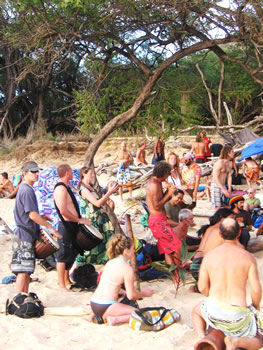
Another experiment in drum dance party creation. All the elements are there: free forum for drummers, whether beginner or expert or anywhere in between; free space for dancers to go for it if they are so inspired; an open-spirited clothing-optional beach where it’s not an issue but a natural ease; perfect powdery sand and rolling blue waves in the hours to sunset and beyond when the fire spinning begins; and whatever refreshments you care to bring or share. There’s even space now and then for didgeridoo, and flute, and a few strums on a guitar, and vocal riffs too.
The real action for me, of course, is the good Guinean rhythms; though they tend to repeat around Makuru, Kaki Lambe and Kuku; and the 6/8 pieces are rare and often lack enough solid players.
Every time is a learning experience - as with any challenging dance class or drum class or jam (and as with any relationship, for that matter). It is also a spiritual training ground because the lessons are about self and group and energy and intention, about expression and respect, cooperation and letting go.
Today’s lessons for me I suppose represent some such archetypal principles ...
1. Letting go. If I made some mistakes, in places where perhaps I did too much or too little, the point is to learn from them and move on. In the “too little” category there’s the issue of confidence and leadership, which I’m reticent to project while still feeling a newcomer on the scene, and in the shadow of unquestioned leadership such as when Glen is there.
2. It’s not about me, anyway. It’s about how I can best contribute to the overall musical experience, the vibe in the public airspace. It is a performance, of a fairly forgiving nature, though there are comments of judgment now and then. The lure is to “sound great” when “sounding good” is maybe a less personal-oriented intention. So letting go of sounding great, especially when it’s actually happening, is the biggest challenge, because, well, it sounds great! Hard to let go, however, of “me sounding great.” Which of course if it does persist as a thought form, usually very quickly runs out the other side where the groove is lost and the magic deactivated; and suddenly I didn’t sound great anymore. This is where people look at each other then and say, “What happened?”
3. Of course the effort to sound great is still worthwhile as a goal for the group or event, and my own participation in that. The focus shifts to the subtlety of the greatness. That is, the precision and power of the rhythm itself, well played. Here nothing fancy is required, but keeping focussed on timing and technique. It’s the safe route, to stick with a simpler part, work on timing, or play shaker - yet in fact some of the sweetest grooving happened tonight, just after sunset, when I played the mini-shaker, alongside the little old unassuming bald guy just riding the steady tambourine. Regardless of instrument, it does no good to force solos or variations. Rather wait till it arises - which it will when freed by a tight foundation - and then enjoy riding it through as a reward and embellishment, after first setting things in order.
4. Not letting go too much. Then there’s just getting carried away. I mean, so carried away that it carries everyone else (or at least the dunun player, which is the most important) away too. Then if I get lost out there I’ve stranded everyone else as well. It’s easy to say, “Well, they should have kept going.” But maybe they stopped when they didn’t trust the soloist anymore, because the solo was no longer coherent to the underlying patterns. Leaving space and weaving around the pattern are both good things to do when soloing; but what must remain tight and solid throughout is at least the skeleton, pulse, template or sense of the underlying rhythm - and whatever of that I don’t play while soloing, I must listen for, to keep my bearings as part of my responsibility to the group. Soloing isn’t a license to wander farther than the group is comfortable with. Paradoxically, the price of the soloist’s freedom is the responsibility of leadership.
I take it as a measure of my previous learning that I don’t get too hard on myself for mistakes anymore. I take criticism and my responsibility for the quality of the groove seriously, but I don’t let it get me down the way I used to, or let myself feel rejected or unworthy if I messed up. I try to check in the awareness and then move on, hopefully putting that awareness to immediate good use.
26 May 2009
Recently I have been listening carefully to recordings of flute melodies I have played in a series of jams with friends. Having studied rhythm and played drums and percussion for twice as long as flute (20 yrs. vs. 10 yrs.) I normally approach music in a rhythmical frame of mind.
At first when entering a jam situation with a melodic element like a flute, I think of it in melodic terms. On a more unconscious level, however, the structure of the flute improvisation ends up being at least as much a rhythmic element as a melodic one.
Everything, after all, has its place in the rhythmic matrix, whether the melodic range is a single bell tone, a high-low or open/mute dunun pattern, or a three-toned djembe part.
Experience with the rhythm instruments with their limited melodic range has led me naturally to playing the flute in a similar way, with emphasis on how it fits in the rhythm. This incorporation of flute as a rhythmic instrument holds true regardless of whether the melody is simple or complex, staccato or atmospheric.
Check out the variety of approaches I've taken to jamming with flute and other instruments, in the new CD release by the jam group Strange Moon: Fierce Light (title taken from the inspiring film of the same name, exploring spiritual activism).

more information | to order from this site: (North America / International)
26 April 2009
A day and a month and a season of accomplishment, transition, clarity, refinement, priority, following through, honoring focus set forward with clear intention, and now enjoying results, and also finding clear space on the other side of what had to be done, to find what has to be done or not done now.
Tonight a great joy to play with Kikeyambay for a hot dance crowd including a large proportion of Africans, again - at least for a couple of numbers, primed by Mane at fourth in the batting order, leading to Sabar Clastique which on the basis of two shows is becoming a Classic, before being settled down by the sultry Yankadi.
1. Sabar
2. Hania
3. Reggae
4. Mane
5. Sabar Clastique
6. Yankadi
7. Djanjo
8. Kairoba
9. Nahadi
8. Zaeko
9. Hania 2
Personally it was fun to get past the stage of worrying about being competent, and relaxing with confidence to feel and dance more into the music, while also giving more power and precision to the parts, and entering more clearly and cleanly off the breaks. In the concert my probem was fatigue or perhaps some lactic acid buildup in my bell hand, with a blister prepared that was then raised by the adhesive tape around the dun sticks.
1. Lolo
2. Koniadon
3. Kassa
4. Mane
5. Fula Fare
6. Soli Rapide
7. Sinte
8. Sorsornet
9. Sabar
10. Konkoba

Earlier in the Earth Day parade, Masala joined forces with Samba du Soleil and paraded through town, leading the crowd behind the banner, objects of multitudes of photographers, playing Phat Beat and Samba Reggae, Kpanlogo, and Samba into the underpass to Centennial Square, taking power away from the Legislature to the circle of grassroots organizations. In the concrete box of the underpass, the volume of the twenty instruments - surdos, snares, bells, kenkeni, tumbao, doumbek, tamborims, shakers, shekere - was deafening, and even so or because it was so the crowd echoed its own roar of approval, resounding in the chamber like an open-air kiva to celebrate the spirit and body of Nature with the most powerful expression our culture can muster ... a unified pulsing field of energy, raising everyone’s vibration to a pitch of joy and transcendence beyond self, shaped by the beautifully chaotic order of a rhythm arrangement, like solar systems and galaxies spread across the canvas of the skies.


+(350x263).jpg)
.jpg)

.jpg)
.jpg)







 Posts
Posts

